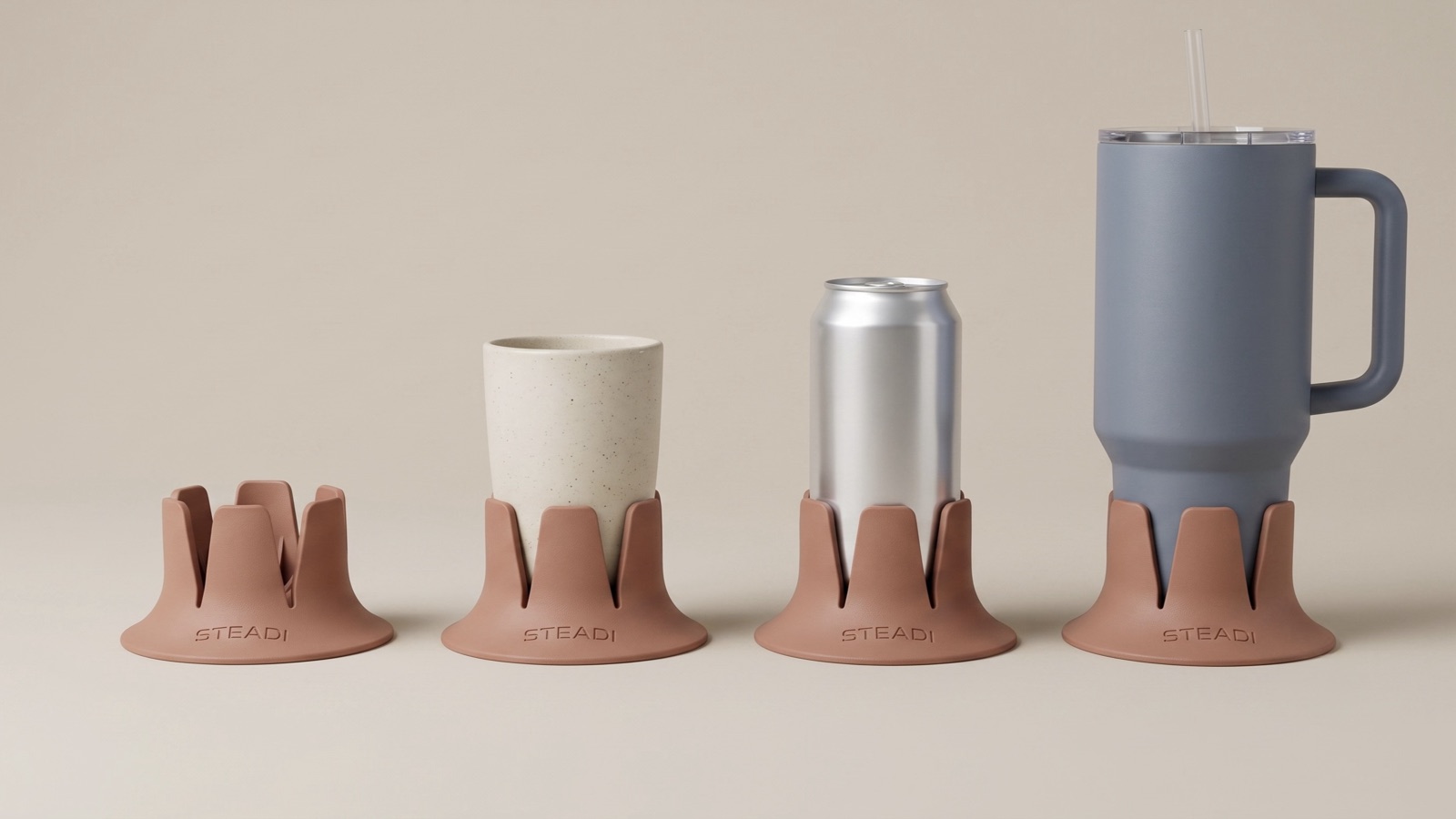
The problem, named
Every flat surface on site already has a job.
Where the drink goes on a jobsite isn't decided once — it gets re-decided each time the crew moves, and none of the regulars were ever built for it.
The tailgate.Doubles as workbench, break table, and staging shelf, ribbed bed liner and all — which means it also gets loaded, unloaded, and slammed shut with whatever's still sitting on it.
The cut table.A sheet of plywood across a pair of sawhorses — the horses — serves as plan table, lunch counter, and saw station all at once. Every cut walks a cup an inch closer to the edge, and the moment someone needs that sheet, the table goes, cup included.
The gang box lid.The lockable steel site chest is the one big surface everyone shares — and the one that opens loudest, thrown back for a tool run a dozen times a shift and launching anything left standing on it.
The lift deck.Up on the scissor lift there's no surface at hand height at all. The drink rides the diamond plate at boot level, where it gets kicked, tips over cords, and rolls to the toe board whenever the platform moves.
The finished floor, at punch-out.Late in a job the only flat spots left are the customer's new hardwood and counters — exactly the surfaces a sweating tumbler rings or a knocked coffee turns into a repair.
Nobody calls in over any of this. It's just a decision the crew re-makes all day, surface by surface, and the drink never actually wins one.
The alternatives
Already riding in the truck, already falling short.
| A PACKOUT-style tool-box cup | The Jobsite Cup Holder |
|---|
| Away from the box or the truck | Nothing to click into out there | Sits on whatever's doing table duty |
|---|
| What it actually needs to work | A PACKOUT wall plate or box lid | No mount — any surface works |
|---|
| Cost | Another purchase to justify | One small piece |
|---|
| Once it's mounted and staying put | Locked to the plate — doesn't budge | Settles in, still moves with you |
|---|
| Following the crew to the next surface | Bolted in place — the crew moves without it | Tucks in a bag, rides along |
|---|
| Room for a 40 oz tumbler | Sized tight — owners ask for bigger | Fits a base up to about 3 inches |
|---|
| Outfitting the rest of the crew | Means another cup, another plate to mount | Just another small piece to grab |
|---|
The modular tool-box cup (PACKOUT-style)It only exists where that stacking system lives — by the door or on the truck, not at the cut table or up on the lift — and it means buying into the whole modular lineup just to hold a drink.
The magnetic cup holderFerrous steel only, so it holds on the gang box and the fender and nothing else — not lumber, not plywood, not drywall, not the fiberglass ladder. And a full 40 oz tumbler is real weight to ask a thin magnetic ring to carry.
The clamp-on cup holderSized for a desk edge, not a sawhorse or a tailgate — the jaws max out at a couple of inches, which rules out most of what's actually on site.
The truck cup holderIt solves tipping by taking the drink out of reach entirely. The coffee goes cold, the water goes warm, and it sits there instead of getting drunk on the regular schedule the heat actually calls for.
The practicalities
Asked on the tailgate, answered here.
Does it actually work on a tailgate or a steel gang box lid?
That's exactly the surface it's built for. Hard, textured, and vibrating isn't a downgrade from anything softer — the wide base and flexible fins grip ribbed liners and diamond plate the same way, and settle a bumped drink back into place instead of letting it walk further toward the edge.
Will it survive saw vibration at the cut table?
Vibration is the whole design problem it answers. The fins hold the drink by its bottom inch, so a circular saw walking the sheet doesn't walk the cup off it — it holds steady through the cut, not just between them.
What about sawdust and mud dust?
It's one piece of solid material with no seams or hinges for dust to work into — rinse it off or wipe it down between cuts. It doesn't keep dust off an open lid, but it keeps the cup itself from sliding while the dust settles.
Does my 40 oz tumbler fit?
It's the base that matters, not the rim — a bottom 2 to 3 inches across fits, the 40 oz Stanley-style tumbler included. A handled mug doesn't: the handle lands right where a fin needs to close.
Can I use it up on a scissor lift?
Yes — the deck is exactly the kind of hard, moving surface it's built for. A bottle set down loose can still get kicked, but the base resists tipping through the lurch and vibration of the lift running, and settles the drink back level.
Does it clamp to the sawhorses or bolt onto anything?
No. Nothing clamps, mounts, or depends on a steel surface to magnetize to. It just sits on top of whatever's doing table duty that hour — the tailgate, the horses, the gang box lid — and moves with the crew to the next one.
Will it hold up to a normal jobsite day?
It's one piece of flexible, molded material with nothing rigid to crack and nothing that comes apart — built for the bumps and drops that are already normal on site.
How do I clean it?
Rinse it or run it through the dishwasher. It's one solid piece of material with nothing to trap dust or grit.
Who makes it, and where do I buy one?
It's called the Steadi, molded in small runs in Orange, California by Steadi Labs. Every order ships free from steadilabs.com, with free returns for 30 days if it's not earning its spot in the tool bag.
All 17 questions, answered →